When a “Normal ECG” Nearly Missed a Heart Attack: A Real Case You Must Know About
- doctorvptalks
- Dec 11, 2025
- 3 min read

Heart attacks don’t always announce themselves loudly. Sometimes, they hide behind “normal” test reports and mild symptoms—making them far more dangerous.
Recently, one of my college seniors went through a frightening experience that highlights this exact reality. His case is an important reminder for patients, families, and even primary-care clinicians: a normal ECG does NOT rule out a heart attack.
This article explains the full story, the medical details, why the ECG was normal, and what everyone should learn from this near-miss.
The Case: When Symptoms Spoke Louder Than the ECG
A few days ago, a senior from my college reached out to me, sounding anxious. He had suddenly developed:
Chest heaviness
Breathlessness
Fatigue
A nagging sense that “something isn’t right”
These are classic warning signs—but what happened next almost changed the outcome.
First Stop: Local Clinic → ECG Done → Declared NORMAL
At the first clinic he visited, an ECG was taken.
The report looked completely normal.
He was told:
“There is no emergency. You’re fine.”
But his symptoms only worsened.
Increasing Breathlessness → Second ECG → Still NORMAL
When he returned to the same clinic with increasing breathlessness, another ECG was done.
Again, he was told:
“Absolutely normal. Nothing to worry.”
This is where most people would have given up and gone home.
But he trusted his instinct.
Decision That Saved His Life: Visiting a Tertiary Hospital
He went to a well-known hospital for a third evaluation—this time by a specialist team.
Within minutes of examination and blood tests, the truth became clear:
He had suffered a heart attack (NSTEMI).
Further evaluation, including coronary angiography, revealed the complete picture.
Final Diagnosis
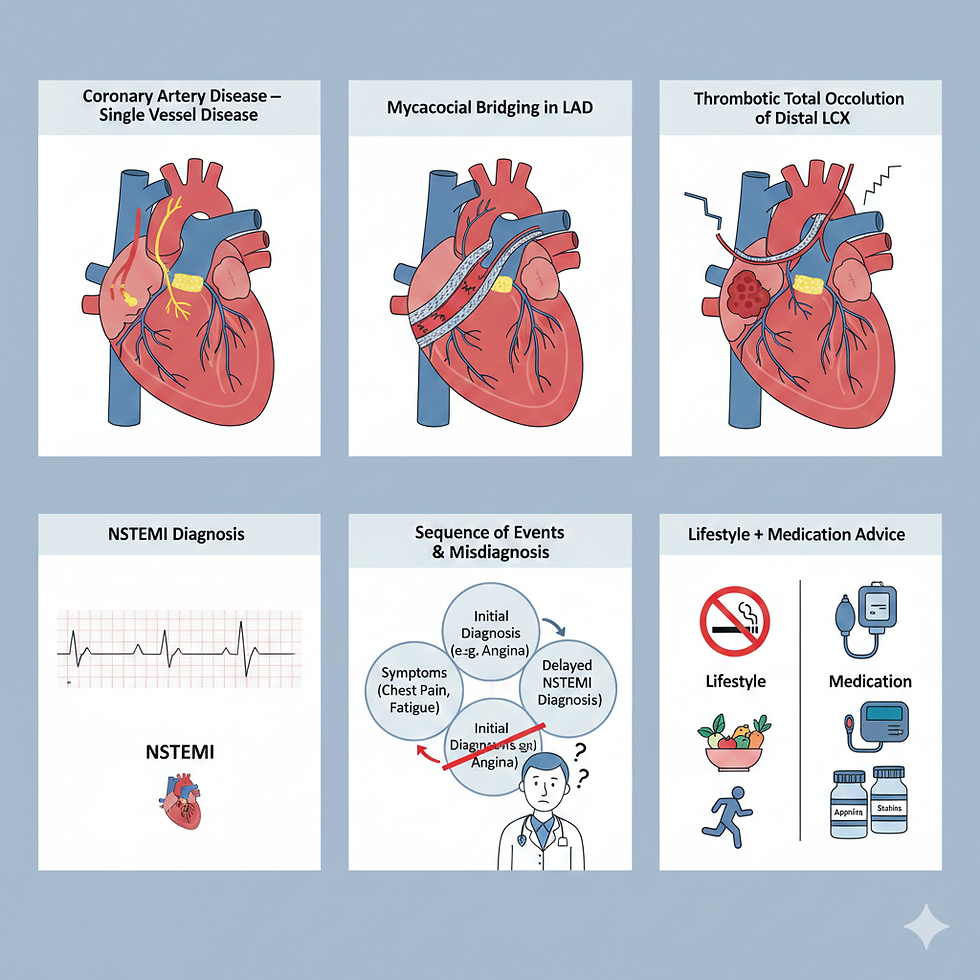
Coronary Artery Disease – Single Vessel Disease
Only one major artery was critically affected.
Thrombotic Total Occlusion of Distal LCX
A blood clot completely blocked the distal Left Circumflex artery—a major blood supply to the heart.
Myocardial Bridging in LAD
A congenital variant where part of the artery tunnels through the heart muscle and gets compressed during contraction. Usually harmless, but may mask symptoms or contribute to ischemia.
ACS – NSTEMI (Non-ST Elevation Myocardial Infarction)
A serious heart attack without the classic ECG changes.
He underwent successful PCI (angioplasty), restoring full blood flow.
Today, he is stable and recovering well.
Why Was His ECG Normal? Understanding the Hidden Patterns
Most people believe:“If ECG is normal, the heart is normal.”This is a myth.
There are several reasons why a heart attack may show a normal ECG:
1. NSTEMI often lacks classic ECG changes
Unlike STEMI, NSTEMI does not always produce ST elevation.
2. LCX artery involvement
LCX-related heart attacks are well known for:
Subtle ECG changes
Sometimes no noticeable changes at all
3. Early-stage ECG limitations
Ischemia may not have progressed enough to show changes.
4. Myocardial bridging complicates detection
It may reduce the classic ischemic patterns.
5. ECG is a snapshot, not a complete story
Symptoms and blood tests (especially Troponins) are equally critical.
This is why every medical guideline emphasizes:ECG alone cannot rule out a heart attack.
What Saved This Patient?
Listening to his symptoms
Not accepting “normal ECG” as the final answer
Seeking a second opinion at the right time
Immediate evaluation and treatment by a cardiac team
Early intervention prevented long-term heart muscle damage.
The Patient’s Commitment After Recovery
After the procedure, he shared with me:
“I am going to follow a healthy lifestyle along with medications. I don’t want to take chances again.”
And that’s the most important part of healing—prevention + discipline + awareness.
Integrative Recovery: Lifestyle + Medications
For patients recovering from NSTEMI and angioplasty, both modern and Ayurvedic principles can work together effectively.
Modern Medicine Essentials
Dual Antiplatelet Therapy (DAPT)
Statins
Beta-blockers
Lifestyle modification
Routine follow-ups
Ayurveda-Inspired Lifestyle
Light, wholesome, heart-friendly diet
Avoiding heavy, oily, and processed foods
Daily gentle movement (walking, yoga)
Stress-reduction practices (breathing, meditation)
Maintaining digestive fire (Agni) to support metabolism
Avoid tobacco, alcohol, and stimulants
Together, these help prevent plaque progression, enhance recovery, and improve long-term cardiovascular health.
Key Takeaways for Every Reader
1. A normal ECG does NOT mean a normal heart.
Symptoms should always be taken seriously.
2. Breathlessness + chest discomfort = immediate evaluation.
3. LCX blockages and NSTEMI often hide on ECG.
4. Always consider a second opinion if symptoms persist.
5. Medications + healthy lifestyle = best long-term outcome.
Concluding Remarks
This case serves as a powerful reminder:Your body whispers before it screams. Don’t ignore the whispers.
If something doesn’t feel right—seek help.If symptoms persist—don’t settle for “normal” reports.And always combine medical treatment with mindful lifestyle choices.
Stay aware. Stay heart-smart. Stay healthy.
— Dr. VP


Comments